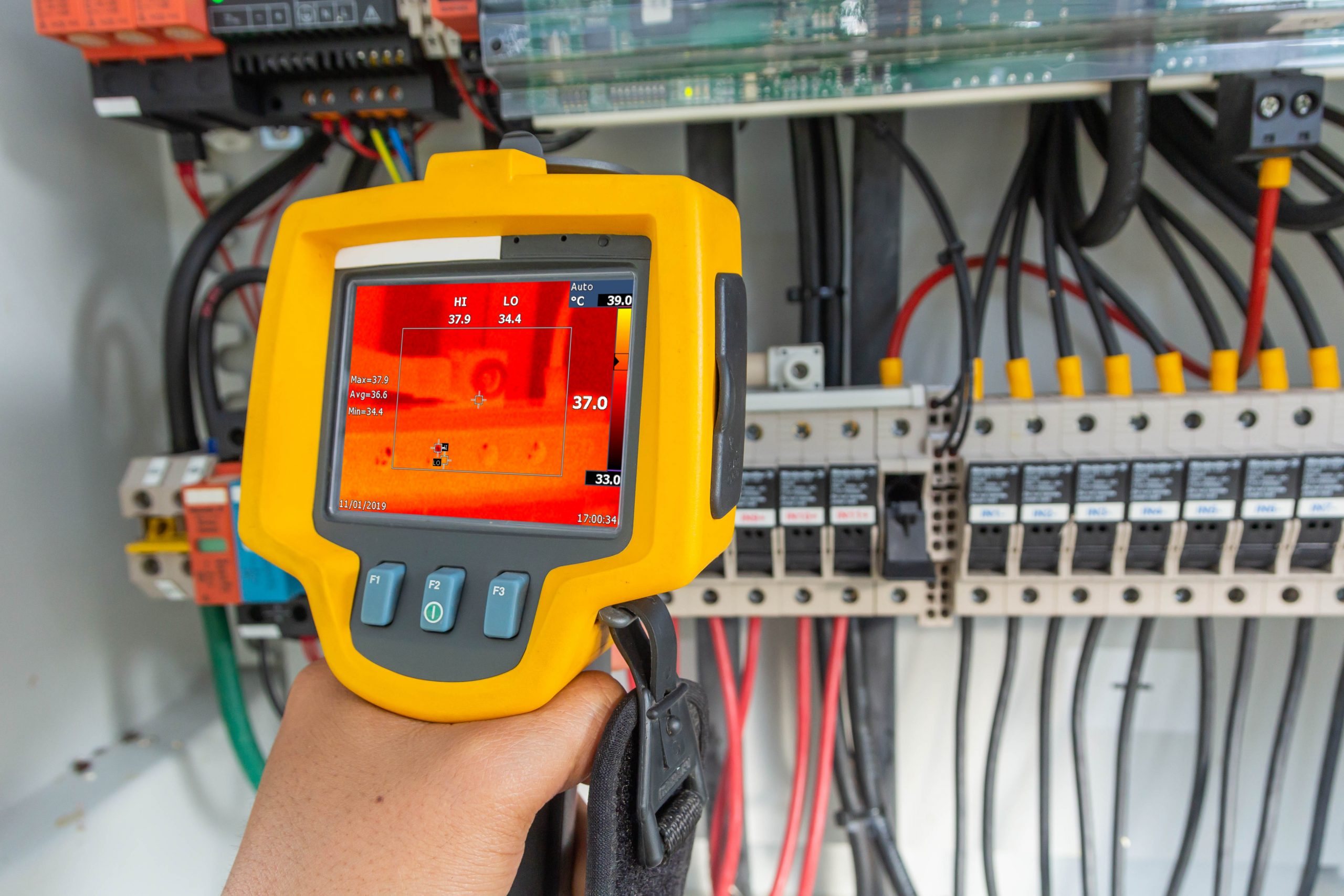
Every year, over 14,000 accidental dwelling fires in the UK are caused by electrical faults—that's more than half of all house fires. For businesses, the stakes are even higher: equipment failure, costly downtime, and potential liability claims. The solution? Electrical thermal imaging surveys that detect invisible problems before they become disasters.
What is an Electrical Thermal Imaging Survey?
An electrical thermal imaging survey (also called thermographic inspection or infrared electrical testing) uses specialised infrared cameras to detect abnormal heat patterns in electrical systems. Every electrical component emits infrared radiation proportional to its temperature—and when something is wrong, it shows up as a "hotspot" that's invisible to the naked eye.
Think of it as giving your electrical system an X-ray. A qualified thermographer can identify problems such as:
- Loose connections – the number one cause of electrical fires
- Overloaded circuits – cables carrying more current than they're rated for
- Phase imbalances – uneven load distribution causing stress
- Faulty components – degraded contactors, breakers, or fuses
- Poor terminations – badly crimped or corroded connections
- Harmonics damage – heat from non-linear loads affecting equipment
Why Electrical Faults Are So Dangerous
Electrical faults don't announce themselves. A loose connection might work perfectly for months while slowly overheating behind the scenes. According to Electrical Safety First, 1 in 4 fires in the UK are caused by electrical faults. In 2022/23 alone, over 5,800 house fires in England were attributed to electrical issues.
The most common culprits include:
- Loose connections create resistance, which generates heat. Over time, this heat damages insulation and can ignite nearby combustibles.
- Overloaded circuits cause cables to overheat, degrading insulation until thermal runaway occurs.
- Arcing faults can reach temperatures of 3,000°C to 20,000°C—hot enough to instantly ignite any nearby material.
The critical point: standard electrical testing (EICR) won't detect these issues. Fixed wire testing checks safety devices work under fault conditions, but it doesn't reveal the slow temperature buildup that precedes most electrical fires.
How a Thermal Imaging Survey Works
A professional thermographic inspection follows a structured process to ensure accurate, actionable results:
1. Pre-Survey Planning
We coordinate with your facilities team to understand your electrical infrastructure, identify critical equipment, and schedule the survey during normal operating conditions. Equipment must be under load to generate the heat signatures we're looking for.
2. On-Site Inspection
Our Level 2 certified thermographer systematically scans your electrical installation using a high-resolution infrared camera (we use 640×480 resolution cameras with wide-angle lenses). This includes:
- Main switchgear and incoming supplies
- Distribution boards and MCB panels
- Contactors and motor control centres
- Transformers and UPS systems
- Cable terminations and bus bars
- Motors, VFDs, and generators
3. Data Analysis
This is where expertise matters. Raw thermal images require professional interpretation. We analyse temperature differentials, identify anomalies, and classify findings by severity using industry-standard criteria.
4. Comprehensive Reporting
Within 24 hours, you receive a detailed report including:
- Annotated thermal images showing all findings
- Temperature readings and delta-T calculations
- Severity classification (Priority 1, 2, or 3)
- Specific location identification
- Recommended remedial actions
- Executive summary for management

The Business Case: ROI of Thermal Imaging
Thermal imaging surveys aren't just about safety—they deliver measurable financial returns:
Prevent Costly Downtime
Unplanned electrical failures can halt production instantly. For manufacturing facilities, the cost of downtime often runs into thousands of pounds per hour. Thermal imaging identifies problems while equipment is still operational, allowing scheduled repairs during planned maintenance windows.
Reduce Fire Risk
Beyond the human cost, electrical fires cause massive financial damage. Insurance claims, business interruption, equipment replacement, and reputational damage can devastate a company. Many insurers now offer premium reductions for businesses with regular thermographic inspection programmes.
Extend Equipment Lifespan
Catching issues early prevents the cascade of damage that occurs when one component fails. A loose connection left unchecked doesn't just fail—it damages surrounding components, turning a simple repair into a major replacement.
Energy Savings
Electrical faults waste energy. A connection with high resistance converts valuable electricity into waste heat. Thermal imaging surveys often reveal efficiency improvements alongside safety concerns.
"Industry data shows thermal imaging programmes deliver a 4:1 return on investment through prevented failures, reduced downtime, and extended equipment life."
When Should You Get a Thermal Imaging Survey?
We recommend thermographic inspections in the following situations:
- Annually – for most commercial and industrial premises
- After EICR testing – to verify no poor connections were introduced
- Following installation work – new equipment, modifications, or upgrades
- For insurance compliance – many policies now require regular surveys
- Before summer/winter peaks – when electrical loads are highest
- When buying property – as part of due diligence
Certain environments particularly benefit from regular thermal imaging:
- Data centres – where downtime costs are extreme
- Healthcare facilities – where power interruption risks patient safety
- Manufacturing – where production continuity is critical
- Schools and universities – with duty of care obligations
- Retail and hospitality – where customer safety is paramount
Thermal Imaging vs. Standard Electrical Testing
It's important to understand that thermal imaging complements rather than replaces standard electrical testing. Here's how they differ:
| Aspect | EICR / Fixed Wire Testing | Thermal Imaging Survey |
|---|---|---|
| What it tests | Safety devices, earthing, insulation | Heat patterns, connection quality |
| Power required | Often requires isolation | Must be under load |
| Disruption | Can require power shutdown | Zero disruption |
| Detects | Faults under test conditions | Developing faults under real load |
| Best for | Compliance certification | Predictive maintenance |
For comprehensive electrical safety, we recommend both: EICR testing for compliance and thermal imaging for predictive maintenance.
When evaluating quotes, consider what's included. At VOLTika, our surveys include high-resolution camera work, Level 2 certified analysis, comprehensive reporting within 24 hours, and follow-up consultation on findings.
Choosing a Thermal Imaging Provider
Not all thermal imaging services are equal. When selecting a provider, verify:
- Thermographer certification – Look for ITC Level 2 or PCN Level 2 certified professionals
- Electrical qualifications – Thermographers should understand electrical systems
- Equipment quality – High-resolution cameras (640×480 minimum) deliver better results
- Reporting standards – Reports should follow BS EN 16714-1 guidelines
- Insurance – Professional indemnity and public liability cover
Standards and Compliance
Professional thermal imaging surveys should comply with:
- BS EN 16714-1:2016 – Non-destructive testing, thermographic testing
- NFPA 70B – Recommended practice for electrical equipment maintenance
- IEEE 1584 – Guide for performing arc flash hazard calculations
- SFG20 – Standard maintenance specification
These standards ensure consistent methodology, reliable results, and defensible reporting.
Take Action Before Problems Become Emergencies
Electrical faults don't wait for convenient timing. A loose connection identified today through thermal imaging is a simple repair. Left undetected, it becomes tomorrow's fire, equipment failure, or production shutdown.
The question isn't whether you can afford a thermal imaging survey—it's whether you can afford not to have one.